header background
logo
批判思考之习惯,钻研刻苦之精神,辩证分析之能力;
追求卓越之信心,积极包容之态度,恪守公正之素养。
期刊论文

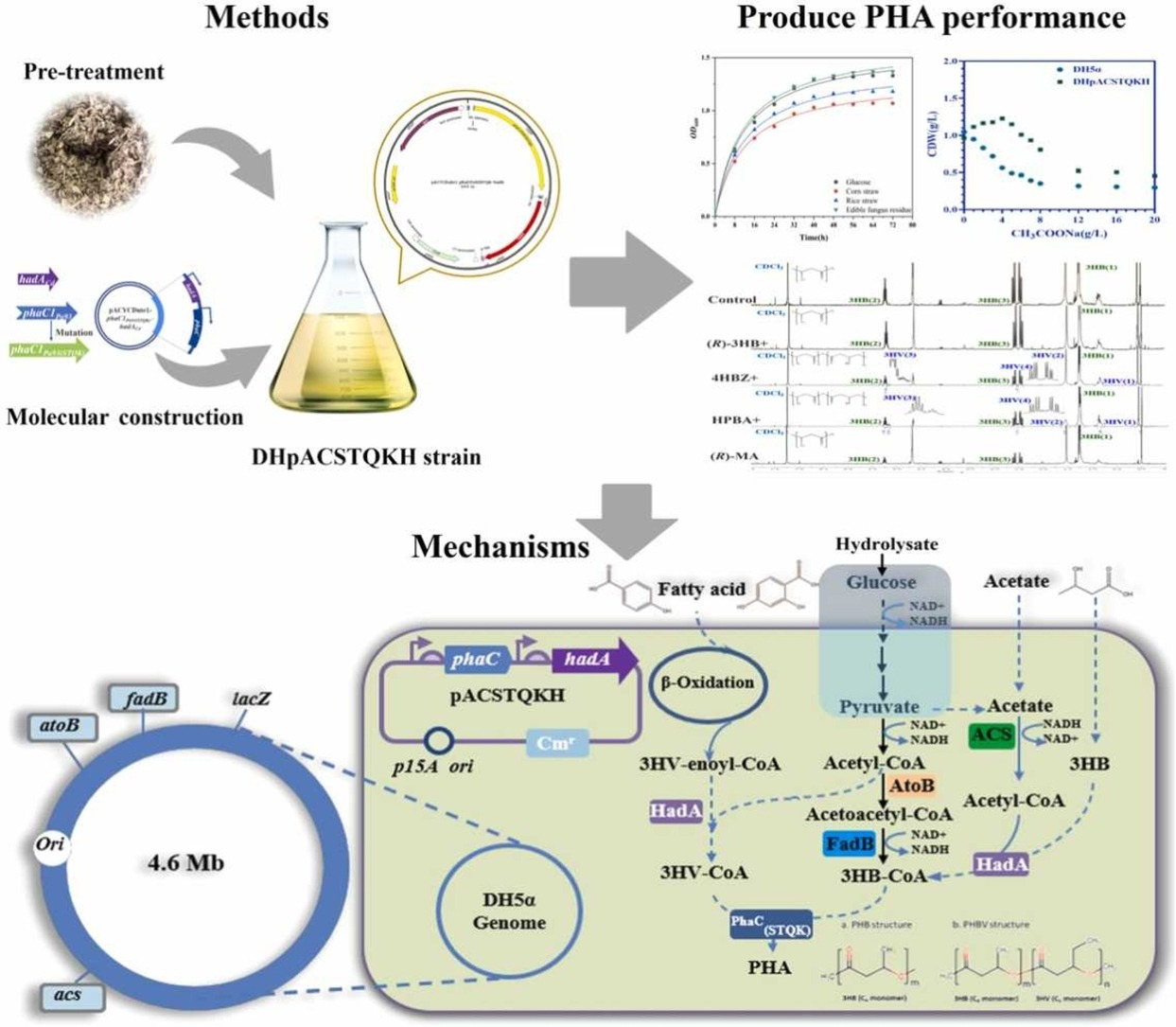
Sustainable polyhydroxyalkanoate production from agricultural by-products via engineered E. coli: Pathway optimization and feedstock valorization

发布时间:2026-05-22 21:07:23 | 访问量:44 | 责任编辑:自动化助手 | 贡献者: 自动化助手
A-
默认
A+

期刊名称

Industrial Crops and Products

发表时影响因子

6.2001

原文链接

https://www.sciencedirect.com/science/article/pii/S0926669025008635

摘要

The high-value utilization of agricultural by-products is of great significance for the development of sustainable materials. HadACd and PhaC1Pa93 are key enzymes in the biosynthesis of polyhydroxyalkanoates (PHA), but their mechanisms have not been fully elucidated. In this study, engineered Escherichia coli strains co-expressing hadACd and phaC1Pa93, or its mutant phaC1Pa93(STQK), were cultivated using hydrolysates derived from edible fungi residues and other agricultural by-products as carbon sources. The PHA synthesis capability and substrate adaptability of these strains were systematically analyzed. Results showed that strains harboring hadACd and phaC1Pa93 efficiently synthesized PHB from (R)-3HB, 4HBZ, HPBA, and (R)-MA, while strains expressing phaC1Pa93(STQK) produced PHBV when 4HBZ and HPBA were used as substrates. Mechanistic studies indicated that HadACd converted endogenous or exogenous 3HB from the E. coli sugar metabolism pathway into 3HB-CoA, which was subsequently polymerized into PHA by PhaC1Pa93, thereby simplifying the biosynthetic pathway for biodegradable PHA. Co-expression of hadACd and phaC1Pa93(STQK) not only broadened the substrate spectrum but also significantly enhanced PHA yield. This study lays a foundation for the design of novel PHA biosynthetic pathways and demonstrates the great potential of agricultural by-products as sustainable and low-cost feedstocks for the production of biodegradable PHA.

AI智评

文献初筛

本文最重要的创新点在于构建了一株能直接利用农业副产物水解液高效合成PHB和PHBV的工程大肠杆菌,且无需引入外源PHA合成酶(PHASCL)途径,关键归因于HadACd蛋白在大肠杆菌中高效介导CoA转移、显著缩短PHA合成路径。研究通过多轮代谢通路重构与发酵验证,在5 L生物反应器规模下实现了稳定PHA产量(>30 g/L),并系统比较了多种农业副产物(如玉米芯、稻壳、甘蔗渣水解液)的适用性,方法可靠、数据完整。值得精读,因其不仅提供了可放大的工艺方案,还揭示了一个被长期忽视的关键限速环节——内源CoA转运效率对PHA合成通量的决定性影响。

综述引用亮点

可引用的核心论点包括:(1)HadACd蛋白可替代传统PHASCL途径实现高效PHA合成;(2)农业副产物水解液经适度预处理即可作为单一碳源驱动高产PHB/PHBV;(3)大肠杆菌内源CoA转运能力是限制异源PHA通路效能的关键瓶颈。本文属于“微生物细胞工厂设计—非粮碳源驱动生物制造”研究方向,延续并拓展了以代谢简化策略提升合成效率的“精简通路工程”流派。它填补了以往研究过度依赖PHASCL强化而忽视宿主辅因子转运适配性的认知空白,与侧重底盘改造(如敲除竞争途径)或聚焦高值PHA共聚物调控的研究形成方法学互补。

研究对比

本文采用的核心方法是“通路最小化+辅因子转运强化”,其独特之处在于摒弃常规PHASCL过表达策略,转而挖掘并验证内源转运蛋白HadACd的功能,将PHA合成步骤从传统4–5步压缩至2–3步。实验以工程E. coli BW25113为底盘,使用真实农业副产物(非纯糖)水解液为唯一碳源,在pH-恒定、DO控制的5 L搅拌罐中完成批次与补料分批发酵,PHA含量达细胞干重75%以上,产量超30 g/L。主要局限在于未系统评估HadACd表达对细胞全局代谢负荷的影响,也未测试该策略在其他工业菌株(如Pseudomonas或Cupriavidus)中的可迁移性;此外,农业水解液中抑制物(如糠醛、乙酸)的耐受阈值及适应性进化策略未深入探究。

吉林农业大学菌物材料团队
地址:吉林省长春市新城大街2888号吉林农业大学食药用菌教育部工程研究中心
办公电话:0431-011211111
邮箱:xiaoshijun@jlau.edu.cn
吉ICP备2025029541号-3
版权所有:吉林农业大学菌物材料团队  技术支持:长春市锐沃科技有限公司