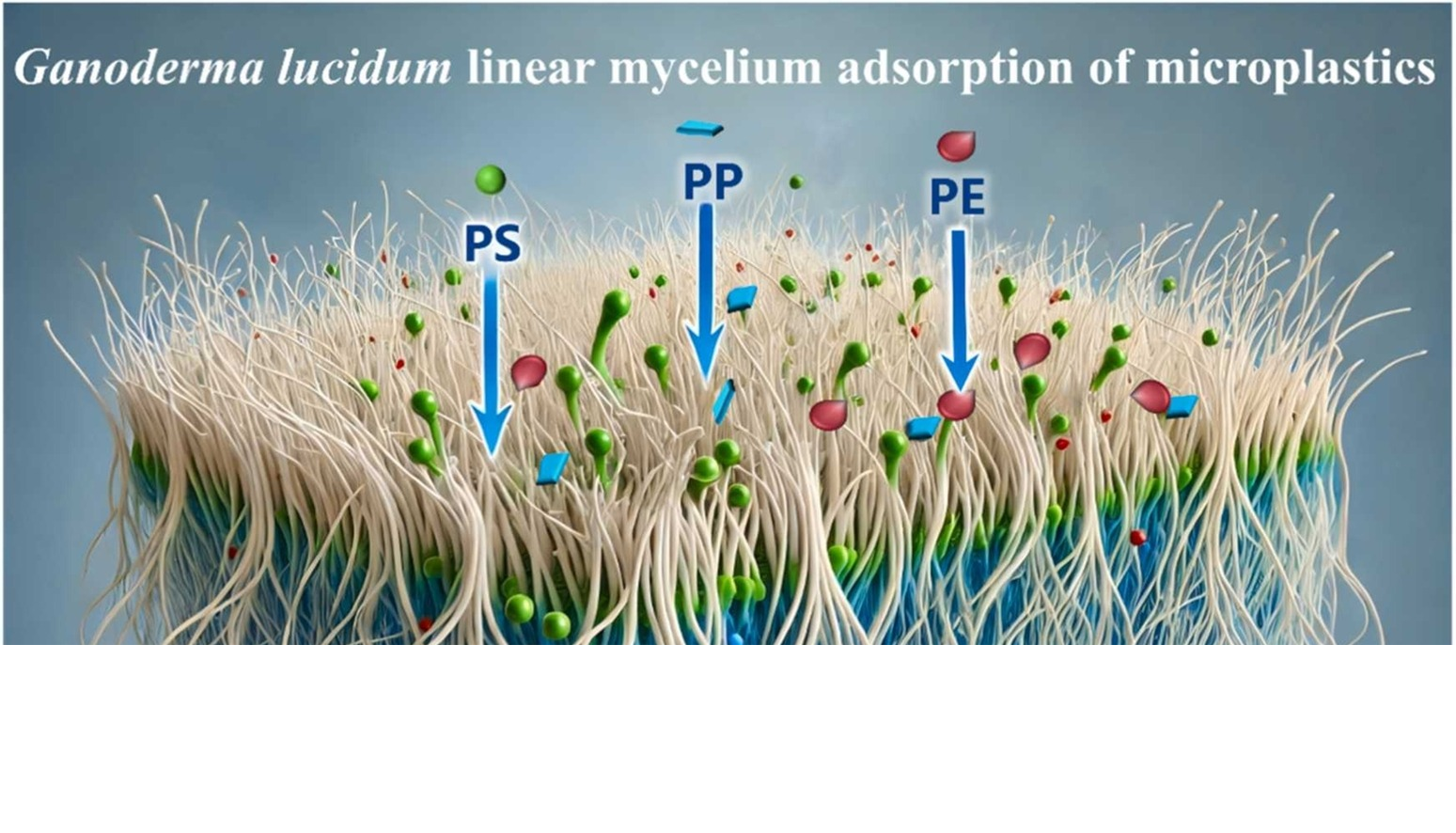
This study comprehensively explores the adsorption capacities of different morphological forms of Ganoderma lucidum mycelium for microplastics (polystyrene-PS, polypropylene-PP, and polyethylene-PE), and delves into the underlying mechanisms of this adsorption process. The results reveal that linear mycelium (AFM) shows the highest adsorption efficiency, with equilibrium adsorption capacities of 311.76 mg・g⁻¹ for PS, 156.39 mg・g⁻¹ for PP, and 102.92 mg・g⁻¹ for PE. Binding energy calculations show that the interaction between chitin and PS is stronger, with a binding energy of −66.39 kJ·mol⁻¹ , compared to that of chitin and PP (-58.47 kJ·mol⁻¹), and chitin and PE (-34.85 kJ·mol⁻¹). This indicates a stronger affinity of chitin for PS. The adsorption process is governed by both physical and chemical interactions. Physical adsorption, driven by van der Waals forces, electrostatic interactions, and interception, allows the mycelium to capture microplastics and block them from escaping. Meanwhile, chemical adsorption is enhanced by functional groups such as amino, carboxyl, and hydroxyl groups, which form stable bonds with the microplastic surfaces. The mycelium’s porous and rough structure provides ample adsorption sites, significantly improving its adsorption efficiency. pH was found to significantly affect the adsorption capacity, with optimal performance observed at pH 5. Additionally, the presence of coexisting ions (Na⁺, Ca²⁺, Mg²⁺) influenced the adsorption efficiency due to competitive interactions, emphasizing the importance of environmental conditions in practical applications. Regeneration tests demonstrated that the mycelium maintained its adsorption ability across five cycles, indicating its potential for repeated use. These results highlight Ganoderma lucidum mycelium as a promising, eco-friendly, and cost-effective material for microplastic remediation.